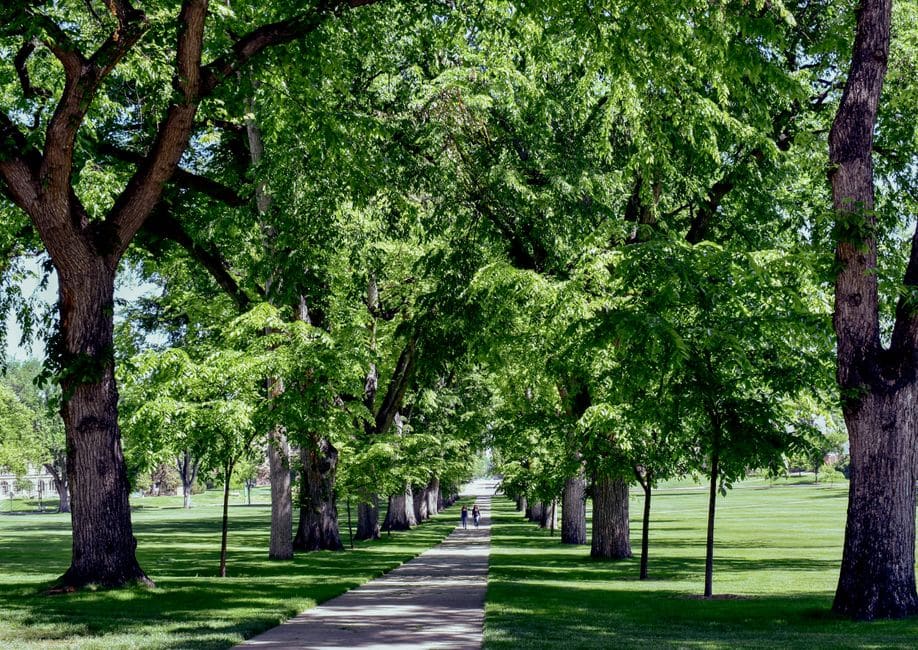
Winnipeg has one of the largest urban elm canopies in North America — an estimated 200,000+ elms line the boulevards of River Heights, Wolseley, St. Vital, and countless other neighbourhoods. That heritage is also a massive liability. Dutch elm disease (DED) has been present in Manitoba since the 1970s, and every summer the City's forestry crews and homeowners wage a quiet battle to contain it. Catching the disease early is the difference between a treatment that saves the tree and a removal bill that can run into the thousands. This guide walks you through the specific symptoms to watch for on a Winnipeg elm, the costs associated with each stage of intervention, and how to decide when a tree can still be saved.
What Are the Symptoms of Dutch Elm Disease in Winnipeg Elms?
Dutch elm disease in Winnipeg elms typically presents first as "flagging" — one or more branches at the upper canopy suddenly wilting and turning yellow or brown while the rest of the tree looks healthy. As the season progresses, leaves on infected branches curl, dry out, and may drop early, while the bark on those branches often shows a distinctive brown or olive-coloured streaking in the sapwood just beneath the surface. If you peel back a small section of bark on a suspect branch and see that dark discolouration running lengthwise, DED is almost certainly the cause. The infection spreads through the tree's vascular system, so by the time symptoms are visible across more than 30–40% of the canopy, saving the tree becomes very difficult.
Early-Season vs. Late-Season Symptoms
Winnipeg's continental climate means elms leaf out relatively late — usually mid-May — giving you a narrow window in June and early July to catch early flagging before the disease has spread widely. Late-season infections detected in August or September may appear to stall over winter, but the fungus overwinters in the wood and resumes spreading the following spring. Do not assume a partially symptomatic tree has recovered just because it survives to the next year.
How the Disease Spreads in Winnipeg's Urban Forest
DED spreads two ways in Winnipeg: through elm bark beetles that carry fungal spores from infected wood to healthy trees, and through root grafts between adjacent boulevard elms. In older residential streets like those in Armstrong's Point or Crescentwood, elms planted close together decades ago often have intertwined root systems, meaning one infected tree can transmit the disease directly to its neighbours underground — no beetle required. This is why the City of Winnipeg prohibits storing elm wood or pruning elms during the high-risk season.
How Much Does Dutch Elm Disease Treatment Cost in Winnipeg?
Treatment for a Winnipeg elm with early-stage Dutch elm disease typically costs between $300 and $900 for a fungicide injection, depending on the tree's diameter and the product used — and this must be repeated every one to three years to remain effective. If the disease has progressed too far for treatment, removal becomes necessary, and professional elm tree removal in Winnipeg generally runs from $800 to $3,500 or more depending on tree size, location, proximity to power lines, and access on your property.
Cost Breakdown by Stage of Infection
| Stage of Infection | Typical Intervention | Estimated Cost (Winnipeg, 2026) |
|---|---|---|
| Early (less than 15% canopy affected) | Fungicide trunk injection + crown pruning of symptomatic wood | $400 – $900 |
| Moderate (15–30% canopy affected) | Aggressive pruning, possible injection — prognosis uncertain | $500 – $1,500 |
| Advanced (30%+ canopy affected) | Full tree removal and stump grinding | $1,200 – $3,500+ |
| Boulevard elm (City-owned) | Report to 311 — City handles removal at no cost to homeowner | $0 to homeowner |
What Affects the Price of Elm Removal in Winnipeg?
Several factors push removal costs toward the higher end of the range. A mature elm on a narrow Wolseley or West End lot with overhead hydro lines and a small gate requires more rigging and labour than an open-yard removal in a newer subdivision like Waverley West. Stump grinding is almost always recommended for DED-infected trees to eliminate root material that could harbour the fungus, and that typically adds $150–$350 to the total. Some contractors also charge a separate fee for hauling and disposing of elm wood, since infected material must be handled carefully to avoid spreading beetle populations.
When Should You Call an Arborist vs. Reporting to the City?
If the elm is on your private property, inside your yard, you are responsible for assessment and removal costs. If the tree is on the boulevard between the sidewalk and the road, it is almost certainly City-owned — report it to 311 and the City's forestry team will inspect and handle it. An ISA-certified arborist can give you a written assessment of whether your yard elm can be saved with injection or needs to come down, and getting that opinion before committing to a removal quote is money well spent. Many Winnipeg arborists offer free or low-cost initial assessments in spring and early summer when they are already conducting neighbourhood surveys.
Is Your Winnipeg Elm Showing Signs of Dutch Elm Disease?
Get a free quote from a local tree removal professional who understands Winnipeg's elm bylaws and can assess your tree quickly before the disease spreads further.
Get My Free QuoteFrequently Asked Questions
Can a Winnipeg elm tree recover from Dutch elm disease on its own?
No — Dutch elm disease is caused by a fungus that progressively blocks the tree's vascular system, and it will not clear up without intervention. Without pruning of infected wood and, in early cases, fungicide injection, the disease will continue to spread and eventually kill the tree within one to several growing seasons.
Is it illegal to cut down an elm tree in Winnipeg without a permit?
Private homeowners can generally remove a diseased elm on their own property, but you must not prune or cut elms during the City's elm pruning ban period (roughly April 1 to July 31) without authorization, as this attracts elm bark beetles. Boulevard elms are City property and must never be cut by homeowners — always report those to 311 and let the City's forestry team manage them.
What do I do with the wood after a DED-infected elm is removed from my Winnipeg yard?
Infected elm wood must not be stored on your property or transported outside Winnipeg, as it can harbour elm bark beetles that spread the disease to healthy trees. The City of Winnipeg requires that DED-infected wood be chipped on-site or disposed of through approved channels — your tree removal contractor should handle compliant disposal, so confirm this is included before signing any contract.